
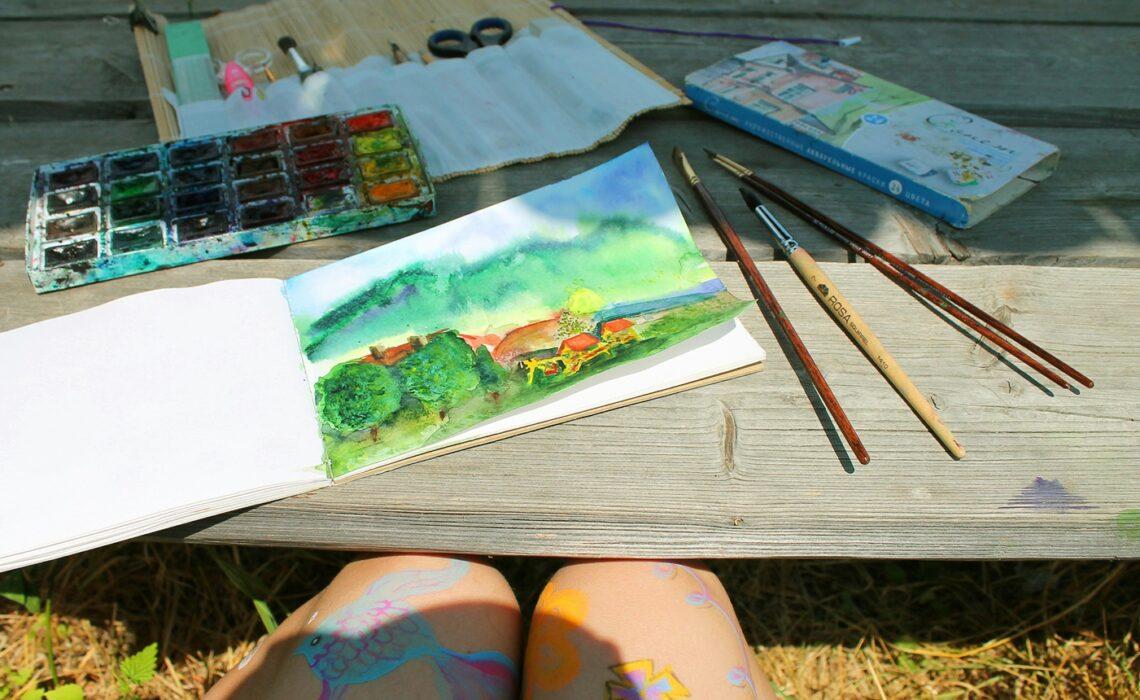
It’s so tempting to buy a whole kit of markers to start drawing or coloring, a whole box filed with tens of threads for embroidery, to accumulate beautiful crochet kits, to get top-notch running equipment… But in the end, why did our hobbies become so expensive and make our cupboards cluttered, and how can we avoid overconsumption when starting a new hobby?
I’m seeing a lot of attention drawn to this topic at the moment, and I got really interested in the link between craft and clutter, especially because I have several such hobbies myself, and admit that I have to be cautious not to buy more than needed (and I sometimes fail, while embracing minimalism principles most of the time).
What made it much more difficult lately is social media and influencer marketing. Hobbies have become a really easy target for this kind of marketing, with numerous online communities and content creators feeding the machine.
Hi there! I’m a French-speaking writer and blogger and most of my content is in French. Please leave a comment to let me know if you enjoy my articles in English and would like me to continue translating my original posts!
A few problems about influencer marketing regarding hobbies
Leisure and overconsumption
Really often, influencer marketing is making us buy and accumulate. Social media are showing us so many possibilities, so many options, that we grow bored with what’s in our hands. Instead of finishing current projects, going through the basics, trying to do more with little material, we grab a new kit, switch to a new variation of the hobby, even buy in advance.
Overconsumption raised because of low price products, but it doesn’t always seem to be that way when it comes to hobbies: in one of the videos* I watched, I discovered there’s a whole community on social networks centered around coloring books, where many people ended up buying high-end markers because some influencers were praising them. I’m not saying you shouldn’t have nice markers for coloring, but I think those particular markers might be a bit over the top…
Either it’s cheap or not, the sole problem is buying more than needed in the first place, especially when we haven’t used up what we already have (or even tried it sometimes). Small prices or high-end products, we waste money and resources, and we clutter our homes.
But it’s getting worse: some influencers are displaying their material or tools, just like a collection. Their rooms look like craft shops. This is transforming our vision of such objects, from useful ones to displayed, unused ones, which in turns creates demand, which creates a waste of resources… The hell loop of overconsumption.
If only those few influencers are doing it, it’s not such a big deal, right? Well… The problem is that influencers do influence people, which means many “crafters” are copying their consumption habits.
Hobbies and pressure
This influence causes more problems, like a tendency to compare oneself to them, or the impression that everything we create should be monetized, professionalized. We’re putting pressure on ourselves to reach some targets, incredibly unachievable ones for most people, or to get as good as influencers who seem to make it all really easily, and often don’t show us their learning phase.
Our hobbies are supposed to help us escape the day-to-day pressure, allow us to grow individually without competing against others, give us opportunities that professional and social obligations take away from us (like, relaxing, making our decisions in total freedom, being messy, being average, being bad, not even evaluating what we do…).
I’m sad to observe this whole phenomenon, because I feel like many people choose a hobby not because they’re personally attracted by the craft itself, but to follow a trend, or in hope they will “make it” on social media. And that’s a real problem, because we cannot really define this activity as a hobby anymore.
When you’re doing a “hobby” just to be able to share about it on the Internet, or try to reach a goal (fame, money, competition…), you’re again falling in the trap of the hustle culture, where everything should be lucrative, productive, and nothing allows you to rest or be yourself without constraint.
I’m a member of a hand embroidery group on a social network, and I cannot keep up with the amount of people asking how to make money from their craft, when you clearly see that they’re just getting started.
How to truly choose a hobby that’s good for you, not for social media or as a side hustle
Before starting a new hobby, make sure you’re doing it for the right reasons, without “bad” influence. Ask yourself:
- Will I enjoy practising if I don’t get anything from it (being seen, money)
- What made me want to start this
- Am I already busy with other things and feel like I don’t have enough time for them
- Do I have to quit something else in order to make time/room/budget for this new craft, and am I ok with it
A hobby is an opportunity to escape from constraints, to grow individually, to learn, to unwind, to choose your pace, so make sure you choose what’s relevant for you and you’re clear from motives that could ruin it for you.
If necessary, try to stop using social networks, or any other source of influence, for a while, and see if it makes you change your mind.
I really liked below post on Instagram and I think it’s a great example of what I’m pointing in this article.
Try it with the bare minimum
When trying something new, it’s difficult to know for sure we will like it. What’s good for others (or what’s trendy) is not necessarily the best choice for us. To avoid accumulating a lot of material for nothing, try it with a minimal toolbox, and give yourself enough time to actually try it. You might like the very fist steps in this new hobby but find out that it becomes too complicated after the basics, or that you quickly grow bored of it.
Don’t try to start fast, au contraire, explore at your pace and with little influence.
- Choose the most basic tool and try it for a long enough period before buying more tools (for example, you can start drawing with a mechanical pen at first).
- Buy individual tools rather than kits. Kits seem like a cheap way to get started, but if you’re not using everything in your kit, it’s not a good deal! It’s better to buy items little by little, if you need them. That’s also a way of spending less in one go.
- You’re thinking about different hobbies? Choose one and really try it before switching to something else.
- You can find some equipment on the second hand market, or ask your friends and relatives if they have what you need (it might be sleeping at the bottom of their own craft cupboard). You can also borrow it for some time before buying your own.
- Group classes can give you a chance to give it a try without having your own material at first.
My own experience with drawing
I’ve been drawing since I was a child, but took a lot of breaks from it. I recently decided to be more consistent. I’m following some illustrators on social media, and I must admit I’ve already been tempted to buy some tools because they were using them and I loved how it looked. I felt like those would allow me to reach (or get closer to) their level, I guess?
Since the pens and pencils I keep on seeing everywhere are a bit pricey, especially for a whole palette, and that I hesitated between different types of media, I decided to get a little sample of each type of pen and pencil I had my eyes on.
I was lucky to find them second hand and to be able to buy less than ten of each type. If would have gone for individual ones bought at an art supply shop.
After trying them on, I realized all the constraints of each type of marker or pencil (which artists never actually mention), and that not all of them were a good fit for me. I also experimented no-color drawing and noticed that my style really showed up when I was just using a black liner. I could come with those conclusions at a low price and without creating demand for new products. Now I can invest in my hobby knowing what’s good for me and what I need.
A few hobby ideas that don’t require (a lot of) material
If you’re still looking for an idea, here’s a list of crafts and hobbies that are easy to start with very few material, or even none at all.
When you find the right hobby for you, there’s no harm in investing in it, as long as you actually use what you buy, and buy what you need when you need it.
Hobbies below can be started with little material investment.
- Writing. There are many hobbies involving writing, and they only require a pen (for handwriting) or a computer (for digital writing). You can journal with a simple notebook, that doesn’t need to be super aesthetic like ones you see on social media, or even journal online. You can write about your thoughts or passions, create travel diaries, send letters, write fiction work…
- Junk journaling. This kind of journaling is made by upcycling “junk” (wrapping paper, magazines, anything piece of paper you’d throw away) into a kind of scrapbook. It only takes a notebook, since everything else you use is paper waste.
- Drawing. You can doodle with the most basic pen, mechanical pencil, or whatever. It’s not necessary to use color, or many of them. Any piece of paper can do, or you can buy one sketchbook. You have children? Borrow color markers from them.
- Singing. No material needed, and it feels so good! You can use the karaoke function of Spotify or look for karaoke videos on the Internet if needed.
- Dancing. You just need your favorite playlist!
- Sport. Many sports are material free or require very little, like body-weight based ones (yoga, pilates…) where a mat is enough (or a towel in the grass), or walking, that only requires a decent pair of sneakers (or a good one if you’re pushing to more difficult hikes). Swimming only takes a swimsuit. There are probably many other examples.
- Sashiko embroidery. This embroidery style from Japan was initially made to repair clothes in a pretty way. It’s now also a way to decorate your clothes and create patterns. Compared to “western” embroidery, it requires very little material and technique. It’s usually done in a single color.
- Wandering in nature. Observe everything around you, insects, trees, plants, fungi, rocks… If you’d like, take photographs, draw, write, make some research about what you see, use a species identifier app…
- Cooking. Try new things that you wouldn’t do yourself usually, using what you have.
- Reading. Get a membership at your local library and this becomes a totally clutter-free hobby! Reading allows you to participate in online or physical reading clubs.
One of the videos that was thought provoking for me and inspired me for this article:
De paragraf legt terecht bloot hoe de invloed van influencers kan leiden tot onrealistische verwachtingen. Door jezelf constant te vergelijken met mensen die enkel hun successen tonen, ontstaat er een vertekend beeld van wat normaal en haalbaar is. Dat kan niet alleen demotiverend werken, maar ook creativiteit onder druk zetten, omdat persoonlijke groei en leerprocessen minder zichtbaar en minder gewaardeerd worden.